


Jewelry packaging carries a strict dual mandate. It must physically protect fragile, high-value items during transit while simultaneously validating the customer's purchasing decision through a premium tactile experience. When a customer receives a piece of jewelry, the box is the first physical interaction they have with your brand. If the presentation feels cheap or the item arrives damaged, the perceived value of the product plummets instantly.
Many brands struggle with the tension between aesthetic ambition and operational reality. Designers often over-index on visual elements while neglecting unit economics, dimensional weight shipping costs, and assembly labor. This oversight leads to eroded profit margins and logistical bottlenecks on the fulfillment line. A beautiful box that takes five minutes to assemble and costs a fortune to ship is a liability, not an asset.
Executing a successful custom jewelry packaging design requires a systematic approach. You must balance brand positioning, structural engineering, and supply chain realities to drive repeat purchases and brand loyalty.
Unit Economics Dictate Design: Effective custom jewelry packaging design requires reverse-engineering from your target Cost of Goods Sold (COGS) to determine viable materials and structural complexity.
Protection Precedes Aesthetics: The most visually striking box fails if it allows chains to tangle, posts to bend, or metals to tarnish during transit.
Execution Paths Scale with Budget: Brands can execute custom packaging via low-cost semi-custom methods (hand-stamping, custom stickers, and ribbons on stock boxes) or scale up to fully customized overseas manufacturing.
MOQs Drive Vendor Selection: Minimum Order Quantities (MOQs) are the primary filter for choosing manufacturing partners, heavily influencing whether a brand opts for domestic semi-custom or overseas fully custom solutions.
The Unboxing ROI: Structured layering (primary container, secondary mailer, inserts) increases perceived value, directly correlating with lower return rates and higher social sharing.
Table of Contents
Packaging acts as the first physical touchpoint of your brand. Before the customer even sees the jewelry, they feel the weight of the box, notice the texture of the paper, and observe the precision of the logo application. The packaging tier must align perfectly with the product's price point. Minimalist kraft paper and lightweight folding cartons suit everyday fashion jewelry, signaling accessibility and modern simplicity. Conversely, fine jewelry demands heavyweight rigid board, soft-touch finishes, and magnetic closures to convey luxury and permanence.
A signature brand color palette builds instant recognition. Ensuring exact color consistency across boxes, tissue paper, ribbons, and mailers requires strict adherence to Pantone Matching Systems (PMS). When a customer sees that specific shade of blue, pink, or deep green, they should immediately associate it with your brand. Inconsistent color matching across different materials dilutes this effect and makes the brand look unpolished. You cannot rely on digital proofs; you must review physical drawdowns on the actual substrates you plan to use.
Jewelry faces specific physical threats during shipping. Impact can crush delicate settings, friction causes micro-scratches on polished metals, moisture leads to tarnishing, and movement results in knotted chains. Your packaging must neutralize these threats before aesthetics even enter the conversation.
Impact Resistance: The exterior mailer and primary box must absorb shock. Rigid boards with a thickness of at least 1200 GSM provide a solid defense against crushing forces in the postal system.
Friction Reduction: Soft interior linings prevent micro-abrasions. Hard plastics or rough papers should never make direct contact with polished metals or soft stones like pearls.
Moisture Control: Anti-tarnish tabs or silica gel packets integrated into the packaging architecture absorb ambient moisture, preventing oxidation during long transit times or warehouse storage.
Immobilization: Custom inserts are non-negotiable. Engineered to the exact dimensions of the pieces, these inserts prevent movement. High-density EVA foam, velvet-wrapped pads, or precisely slotted cards keep earrings fixed, rings centered, and necklaces separated.
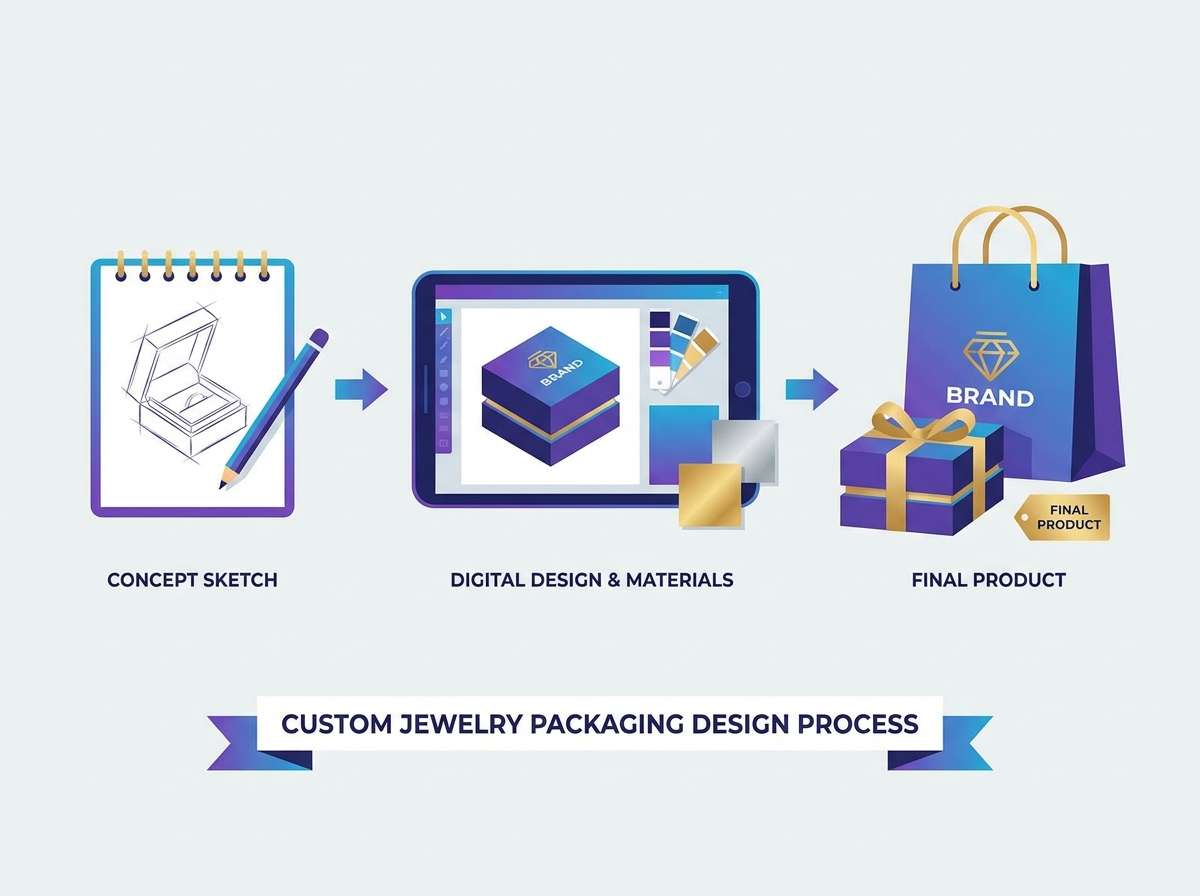
Calculating the total landed cost of packaging is essential for maintaining healthy margins. This calculation includes manufacturing costs, freight, storage fees, and the labor time required for assembly. A box that costs very little to manufacture might be bulky, driving up shipping and storage expenses. You must look at the entire lifecycle of the box, from the factory floor to the customer's hands.
Establish strict baseline rules for packaging allocation. Determine what percentage of the product's retail price can realistically go toward packaging without compromising profitability. High-margin fine jewelry can absorb higher packaging costs, while low-margin fashion jewelry requires rigorous cost control. Reverse-engineer your design choices based on this target allocation. If your budget is tight, prioritize a high-quality primary box and use a standard unbranded mailer, rather than spreading a small budget too thin across multiple mediocre layers.
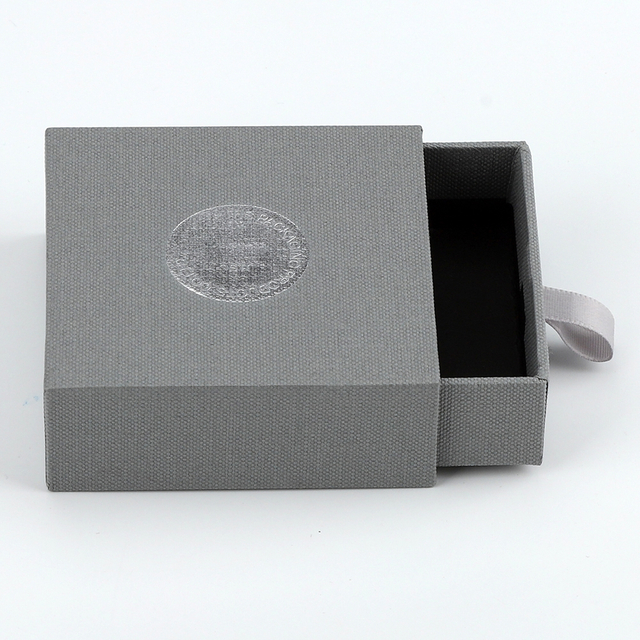
The primary vessel holds the jewelry directly and often serves as a long-term storage solution for the customer. Drawer-style rigid boxes offer a smooth pull mechanism that feels premium. Magnetic closure boxes provide a satisfying snap, reinforcing the perception of quality. Hinged clamshells are traditional and highly protective, while microfiber or velvet pouches offer a softer, more casual presentation.
Window display packaging utilizes acetate windows to showcase the product directly inside the box. This strategy works exceptionally well in physical retail environments where visual merchandising drives impulse purchases. Furthermore, high-quality primary packaging has significant retention value. Customers keep sturdy, beautiful boxes for years to store their jewelry, keeping your brand logo visible on their dressers. When designing a keepsake box, specify a matte lamination or anti-scratch coating to ensure it holds up to years of handling.
Custom jewelry cards hold items secure within the primary box or pouch. Earring, necklace, and ring cards must be structurally sound to prevent tearing. Material options include recycled chipboard for a rustic look, textured linen paper for elegance, or heavy plastic for durability. Regardless of the material, cards must possess anti-tarnish properties to protect the metals.
Card layouts require precise engineering. Integrated tabs, specific earring hole placements, and fold-over flaps for necklaces are critical design elements. A well-designed necklace card wraps the excess chain securely behind the display face, eliminating the risk of knotting during transit. When creating dielines for these cards, ensure the die-cut slots are wide enough to accommodate the thickest part of your chain clasps without forcing the fulfillment team to struggle during assembly.

The secondary packaging protects the primary box from the harsh realities of the postal system. Corrugated mailer boxes offer the highest crush resistance. Bubble mailers are lightweight and suitable for less fragile items, while rigid or stamped kraft envelopes work well for flat, low-profile pieces.
Brands face a trade-off between branded and unbranded exterior packaging. Highly branded mailers create excitement on the doorstep and build brand recognition. However, for high-value fine jewelry, unbranded exteriors act as a theft deterrent. Shipping a diamond ring in a box covered in luxury branding invites interception. A common compromise is using a plain exterior mailer with heavy branding printed on the inside lid, delivering a secure transit experience that still provides a branded reveal upon opening.

The mechanics of securing the jewelry dictate the user experience. Ribbon pulls make it easy to slide out drawers or lift inserts without damaging the box. Snap closures on pouches keep items contained. Custom-cut EVA foam provides exact-fit protection, while anti-tarnish cotton inserts offer a softer touch while absorbing ambient moisture.
When specifying foam inserts, request high-density EVA rather than standard PU foam. PU foam degrades over time and can leave a sticky residue on jewelry, whereas EVA holds its shape, allows for precise die-cutting, and provides a cleaner presentation. If using velvet-wrapped foam, ensure the velvet is securely glued to the foam base to prevent peeling at the edges.
Choosing between rigid setup boxes and folding cartons fundamentally changes your supply chain and presentation. Rigid boxes offer high perceived value and require no assembly, but they take up significant shipping and storage volume. Folding cartons cost less and ship flat, saving on freight, but they require fulfillment staff to fold and assemble them on the packing line.
Feature | Rigid Setup Boxes | Folding Cartons |
|---|---|---|
Perceived Value | Premium / Luxury | Standard / Accessible |
Assembly Required | None (Ready to use) | Yes (Labor time required) |
Shipping & Storage Volume | High (Ships fully formed) | Low (Ships flat) |
Structural Protection | Excellent crush resistance | Moderate protection |
Tooling Costs | Higher initial setup | Lower initial setup |
The interior lining interacts directly with the jewelry. Velvet and suede provide a classic luxury feel and excellent scratch protection. Microfiber offers a modern, sleek alternative that easily wipes clean. Organic cotton appeals to environmentally conscious consumers.
When selecting textiles, specifying sulfur-free and acid-free materials is a strict requirement. Standard fabrics and glues often contain trace chemicals that accelerate metal tarnishing. Using untreated materials will ruin silver and gold-plated items before they even reach the customer. Always request material safety data sheets (MSDS) from your supplier to verify the chemical composition of the linings and adhesives used in your custom jewelry packaging.
Consumer demand for sustainable packaging continues to grow. Realistic green materials include FSC-certified paper, which ensures responsible forestry, and soy-based inks that are easier to recycle than petroleum-based alternatives. Molded pulp offers excellent structural protection and is fully compostable, while compostable mailers replace traditional poly mailers.
Avoid greenwashing by understanding the actual durability limitations of certain recycled materials. Heavily recycled paper fibers are shorter and weaker, meaning a 100% recycled box might not survive rough transit without additional structural support. Balance sustainability goals with the primary mandate of product protection. A damaged piece of jewelry that requires return shipping and replacement has a much larger carbon footprint than a slightly less sustainable, but highly protective, box.
The psychology of unboxing relies on structured layering. A well-mapped sequence builds anticipation and reinforces the value of the purchase. You must engineer the physical steps the customer takes to reach the product.
The Exterior Seal: A custom tamper-evident tape or branded sticker secures the mailer.
The First Look: Opening the mailer reveals custom tissue paper or a branded thank-you card resting on top of the primary box.
The Primary Box: The customer lifts the heavy, textured lid or slides open the drawer.
The Final Reveal: The jewelry is presented perfectly centered on a custom insert, free of tangles or damage.
Friction—the time and effort it takes to open the package—plays a role in perceived value. Slight friction makes the reveal feel earned and special. However, excessive tape or impossible-to-open clamshells cause frustration. The goal is a deliberate, paced reveal. Ensure that ribbon pulls are long enough to grasp easily and that magnetic closures have the right amount of resistance.
Premium finishes elevate standard materials into luxury touchpoints. Blind embossing raises the logo without ink, creating a subtle, tactile effect. Debossing presses the design into the material. Hot foil stamping applies metallic foil for high contrast and shine. Spot UV adds a glossy layer to specific areas, while soft-touch lamination gives paper a velvety feel.
Correlate specific finishes with your brand archetype. Minimalist and modern brands often lean toward blind deboss or spot UV on matte backgrounds. Traditional luxury brands frequently utilize gold or silver hot foil stamping to communicate heritage and high value. When combining finishes, such as foil stamping over soft-touch lamination, work closely with your printer to ensure the foil adheres properly, as some laminations resist foil transfer.
Adding a personalized touch increases customer loyalty, but it must be scalable to avoid bottlenecking fulfillment. Variable data printing allows you to print unique thank-you cards or custom packing tape for different customer segments. QR codes printed on inserts can link directly to digital care instructions or styling videos.
Inserting handwritten notes is highly effective but labor-intensive. Utilize semi-custom cardstock with pre-printed branding on one side and a designated blank space on the back. This allows fulfillment staff to quickly write a name or a short phrase without writing the entire message from scratch. Keep markers or pens at the packing station that match your brand colors to maintain a cohesive look.

Emerging businesses often start with low-barrier-to-entry branding methods. Hand-stamping kraft boxes with custom rubber stamps, applying custom sticker seals, or wrapping generic stock boxes with branded satin ribbons allows for strong branding without massive upfront capital. This approach keeps inventory lean and allows for rapid iteration based on customer feedback.
Industrial customization scales with the business. This path involves custom-molded inserts, bespoke dimensions engineered to the millimeter, and high-end automated assembly. While the upfront investment in tooling and dies is significant, industrial customization lowers the per-unit cost at high volumes and ensures absolute consistency across thousands of units.
MOQs dictate the level of customization available to your brand. Domestic suppliers generally offer lower MOQs and faster lead times, making them ideal for testing new designs or scaling slowly. However, their per-unit manufacturing costs are higher due to domestic labor rates.
Overseas manufacturers require high MOQs to justify the setup costs of custom molds and printing plates. While the unit cost drops significantly, you must account for long freight times, import duties, and the capital tied up in large inventory runs. Always factor in a 10-15% buffer for defective units or shipping damage when ordering large overseas runs.
Never proceed to mass production without requesting physical prototypes. White samples allow you to test the structural integrity and fit of the jewelry, while printed proofs confirm the visual execution. Skipping this step often results in thousands of unusable boxes. Test the white sample by placing your heaviest piece of jewelry inside and shipping it to yourself across the country to evaluate real-world transit performance.
Color discrepancy between digital screens (RGB) and physical print (CMYK) is a major risk. Screens emit light, while paper absorbs it. Rely on Pantone Matching Systems (PMS) to ensure your brand colors remain consistent across different materials, from rigid boards to fabric ribbons. Request physical drawdowns of your PMS colors on the exact paper stock you plan to use, as the paper's base color and texture will alter the final appearance of the ink.
Bulky packaging carries hidden costs. Major carriers use dimensional (DIM) weight pricing, meaning you are charged for the volume the box takes up in the truck, not just its actual weight. Shaving just a few millimeters off a custom box design can drastically reduce annual shipping expenses. Work with a structural engineer to optimize the dieline for the tightest possible footprint that still provides adequate crush zones.
Assembly time directly impacts labor costs. A complex folding carton with multiple inserts might save money on manufacturing but will cost more in warehouse labor if it takes three minutes to assemble per order. Optimize designs for swift, intuitive packing on the fulfillment line. Use self-locking tabs and pre-assembled inserts wherever possible to keep fulfillment times under 30 seconds per order.
Successful custom jewelry packaging combines attractive design, reliable product protection, efficient manufacturing, and a memorable customer experience. By carefully selecting materials, packaging structures, branding techniques, and production methods, jewelry brands can create packaging that not only protects valuable products but also strengthens brand identity and encourages long-term customer loyalty.
Choosing the right manufacturing partner is equally important for achieving consistent quality and scalable production. Shenzhen ITIS specializes in custom jewelry packaging and luxury jewelry boxes for global brands, offering innovative packaging design, premium materials, sustainable solutions, and flexible OEM/ODM manufacturing services. Supported by advanced production capabilities, strict quality control, and extensive customization experience, Shenzhen ITIS helps customers develop packaging solutions that balance aesthetics, functionality, and cost efficiency.
Design packaging that aligns with your brand positioning and target customers.
Select premium, anti-tarnish materials to ensure long-term jewelry protection.
Optimize packaging structure to improve shipping efficiency and reduce operational costs.
Work with experienced manufacturers that provide professional design support, reliable production, and consistent quality.
Before selecting a custom jewelry packaging manufacturer, evaluate their design expertise, production capabilities, quality management systems, OEM/ODM experience, and ability to deliver packaging solutions that support your brand's long-term growth.
A: Costs vary widely based on volume, materials, and structural complexity. Simple folding cartons require a lower investment, while premium rigid boxes with foil stamping and custom inserts demand a higher budget. Higher order volumes significantly reduce the per-unit cost by amortizing setup fees across a larger run.
A: Preventing tarnish requires eliminating reactive chemicals. Use acid-free paper, sulfur-free glues, and specially treated anti-tarnish cloth, microfiber, or velvet inserts. Standard untreated fabrics and adhesives often emit gases that accelerate the tarnishing process on silver and plated metals.
A: The semi-custom path is highly effective. Purchase wholesale unbranded boxes and elevate them using custom-designed rubber stamps with permanent ink. Add branded sticker labels to seal mailers, and wrap the primary boxes with custom-printed ribbon to create a premium feel.
A: Fully custom rigid boxes manufactured overseas typically require MOQs ranging from 1,000 to 3,000 units to offset setup costs. Domestic semi-custom options, such as stamping or applying stickers to stock boxes, often have much lower MOQs, sometimes starting at just 100 units.
A: Shipping carriers charge based on the volume a package occupies, not just its physical weight. Because jewelry is light, an oversized box will trigger higher dimensional weight fees. Optimizing the box size to be as compact as possible reduces shipping costs significantly.


