


Shipping and storage costs can add significantly to the total cost of jewelry packaging. Traditional rigid jewelry boxes arrive fully assembled and take up space even before they are used. Collapsible jewelry boxes can be shipped and stored flat, helping brands use warehouse space and freight capacity more efficiently.
However, lower shipping costs do not automatically mean lower total costs. Buyers also need to consider box construction, assembly labor, product protection, and the customer unboxing experience.
This guide explains how collapsible jewelry boxes work, where they can reduce packaging costs, and what brands should evaluate before placing a bulk order.
Table of Contents
The main advantage of a collapsible jewelry box is its flat-packed shipping format. Instead of transporting fully assembled boxes with empty internal space, suppliers can ship many designs in a flat condition. The boxes are assembled when needed.
This approach can improve space utilization throughout the supply chain. The actual savings depend on box dimensions, board thickness, packaging configuration, order quantity, and transportation method.
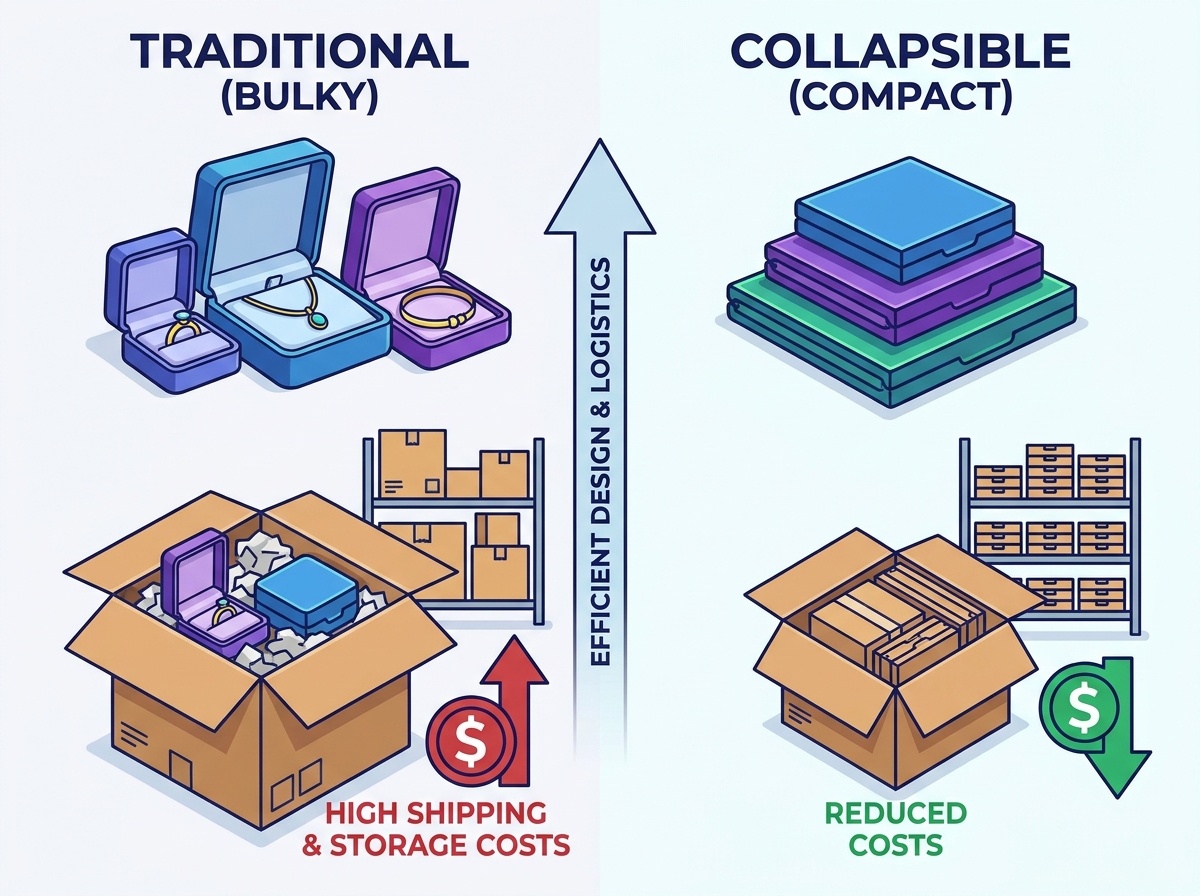
Fully assembled rigid boxes occupy their complete three-dimensional volume during shipping. Their empty interiors cannot always be used efficiently, especially when the boxes have fixed shapes and cannot nest together.
Collapsible boxes reduce this problem by arriving flat. More units may fit into a shipping carton, pallet, or container, depending on the design. This can lower the allocated freight cost per box and improve the efficiency of bulk shipments.
For brands importing jewelry packaging from overseas suppliers, comparing the packed dimensions of both designs is an important first step.
Storage space is another major cost factor. Fully assembled boxes can occupy considerable shelf and pallet space before they reach the packing station.
Flat-packed boxes can be stacked in compact bundles, making them easier to organize and store. This may free up warehouse space for jewelry inventory, finished products, or other packaging materials.
To estimate the potential benefit, compare the storage volume of the same number of flat-packed and assembled boxes. Use the actual carton dimensions and stacking configuration rather than relying on a general space-saving percentage.
Collapsible jewelry boxes mainly reduce the volume required to transport and store packaging inventory. They do not automatically reduce the shipping cost of every customer order.
Outbound savings depend on the final shipping package. If a smaller assembled box allows the jewelry to fit into a smaller mailer, the shipment may qualify for a lower dimensional-weight charge. If the outer package size remains unchanged, the shipping cost may not change.
Brands should therefore evaluate inbound freight, warehouse storage, and outbound parcel costs as separate factors.
Different folding structures suit different products, budgets, and presentation requirements. Choosing the right design helps balance shipping efficiency with protection and brand appearance.

Magnetic closure folding boxes use a folding rigid-board structure with a magnetic closure. They can be shipped flat and assembled into a box with a book-style opening.
This design is suitable for jewelry brands that want a premium presentation while reducing the space required for shipping and storage. Custom printing, foil stamping, embossing, and specialty paper can help maintain a distinctive brand appearance.
However, the structure can require more complex production and manual assembly. It may also be less suitable for very small or shallow boxes, depending on the design.
Before ordering, check the folding structure, hinge durability, magnetic alignment, and finished-box appearance.
Two-piece designs use a separate base and lid that are assembled from flat components. Depending on the construction, folded edges and locking features help create the final box shape.
These boxes can suit brands that need straightforward packaging for fashion jewelry, gift sets, or subscription products. The actual cost and assembly time depend on the board material, closure design, and number of folding steps.
Buyers should confirm that the assembled box remains stable and that the lid fits securely after repeated handling.
Envelope and sleeve designs use a slim outer structure with an insert, card, or pouch to hold the jewelry. They are often suitable for lightweight items such as small pendants, chains, and stud earrings.
Their compact format may reduce packaging volume and help brands use smaller shipping mailers. However, this design does not provide the same presentation or rigid protection as every folding rigid box.
Select this format when a slim profile and simple presentation meet the product's protection requirements.
A lower freight bill is only one part of the financial comparison. Buyers should evaluate the total cost of each packaging option across manufacturing, transportation, storage, and fulfillment.
A collapsible box may use rigid board, printed paper, magnets, hinge materials, inserts, and finishing processes. Complex folding structures can require additional processing and assembly.
As a result, the unit manufacturing price may not always be lower than that of a standard rigid box. Compare quotes for equivalent dimensions, materials, finishes, inserts, and order quantities.
Ask suppliers to provide the packed carton dimensions, quantity per carton, carton weight, and pallet configuration where applicable.
Use these details to estimate the freight cost per unit and storage volume. For international shipments, the shipping method and carrier pricing rules also affect the final cost.
A useful comparison should include the same order quantity and delivery conditions for both packaging formats.
Flat-packed boxes require assembly before use. The time needed depends on the design, worker experience, and packing workflow.
A simple folding box may take less time to assemble than a magnetic box with several panels and alignment steps. Instead of assuming a standard assembly time, test a sample batch with the intended packing team.
Calculate labor cost using the measured assembly time and the relevant hourly labor rate. If the packaging will be used at high order volumes, even a small difference in assembly time can affect the total cost.
Use the following framework to compare packaging options:
Cost Factor | What to Measure |
|---|---|
Manufacturing | Unit price, material specification, inserts, and finishing |
Inbound freight | Shipping volume, carton quantity, transport method, and freight allocation |
Storage | Carton dimensions, required shelf or pallet space, and storage period |
Assembly labor | Measured assembly time multiplied by the applicable labor rate |
Outbound shipping | Final mailer dimensions, parcel weight, and carrier pricing |
Quality and returns | Damage risk, closure failures, assembly defects, and replacement costs |
The best option is the one that delivers the required appearance and protection at the lowest practical total cost, not necessarily the one with the lowest factory price.
Reducing packaging volume should not compromise jewelry protection or the customer experience.
Internal inserts help keep jewelry in position during shipping. Depending on the product, options may include paperboard cards, foam, fabric-covered inserts, or molded trays.
Necklaces and chains need suitable attachment points to reduce movement and tangling. Rings and earrings may require shaped slots or cushioning to prevent shifting.
The insert should fit the assembled box securely without making folding or packing unnecessarily difficult.
Folding hinges are important stress points. Poorly designed hinges or unsuitable wrapping materials may crack, peel, or become misaligned after repeated use.
For magnetic boxes, the closure should align properly and hold the lid securely. The required magnetic strength depends on the box structure, lid weight, and intended use.
Ask for samples and check folding consistency, closure performance, surface finish, and box alignment before approving mass production.
Collapsible packaging can support a premium presentation when the board, wrapping paper, printing, and finishing are well matched to the brand.
Options such as foil stamping, embossing, textured paper, and custom-colored interiors can improve visual appeal. However, finishing choices should be evaluated alongside their effects on unit price, production time, and material availability.
The finished box should be evaluated after assembly, not only in its flat-packed condition.
Packaging design affects how quickly and consistently orders can be prepared. A flat-packed box saves storage space, but the assembly process must fit the packing team's workflow.
Before full implementation, test the packaging at the actual packing station. Measure the time required to assemble the box, insert the jewelry, close the package, and prepare the order for shipment.
For higher-volume operations, teams may assemble a batch of boxes before peak packing periods. Lower-volume brands may prefer assembly on demand to reduce the number of pre-assembled boxes occupying work surfaces.
Clear assembly instructions can help maintain consistency across shifts. Staff should know how to fold the box, position the insert, align the closure, and check the finished package.
ITIS provides customized jewelry packaging and production services. Its OEM jewelry packaging solutions describe a workflow that includes design, sample production, quality control, sample confirmation, and delivery.

Before switching from rigid boxes to collapsible jewelry boxes, prepare a clear packaging specification.
Confirm the following details with your supplier:
Box dimensions: Specify the assembled size and the flat-packed size.
Materials: Confirm the board, wrapping paper, inserts, and finishing requirements.
Folding structure: Review the folding sequence, hinge construction, and closure design.
Protection: Test whether the insert holds the jewelry securely during handling and transit.
Packing efficiency: Measure assembly time and check whether the design suits the packing station.
Shipping configuration: Request carton dimensions, units per carton, and pallet details where relevant.
Quality control: Approve a physical sample before bulk production and define the inspection criteria.
Order economics: Compare manufacturing, freight, storage, labor, and potential replacement costs.
ITIS explains that box structure, dimensions, materials, and processing choices can affect the quotation for custom jewelry packaging. Review its packaging quotation information when preparing a cost comparison.
Collapsible jewelry boxes can help jewelry brands reduce inbound shipping volume and use warehouse space more efficiently. They can also support premium packaging when the structure, inserts, materials, and finishing are designed for the intended product.
The key is to evaluate the entire packaging workflow. Compare unit price, freight, storage, assembly labor, outbound shipping, and product protection before deciding whether a collapsible design is the right fit.
Request samples, measure actual assembly time, and compare packed dimensions before placing a bulk order. For custom designs, contact ITIS to discuss box structure, materials, printing, and production requirements.
The amount depends on the box dimensions, folding structure, and storage configuration. Compare the actual packed volume of the same quantity of flat-packed and assembled boxes to estimate the space savings.
They can reduce inbound freight costs by allowing more units to fit into a shipping carton, pallet, or container. Outbound savings depend on whether the final customer package becomes smaller and how the carrier calculates shipping charges.
Performance depends on the board, hinge construction, closure, inserts, and assembly quality. Test samples for structural stability, closure alignment, and product protection before approving bulk production.
Not always. Some designs require additional folding processes, magnets, or manual assembly. Compare manufacturing, freight, storage, and labor costs to determine the total cost per usable box.
Yes, when the design meets the brand's presentation and protection requirements. Custom paper, printing, foil stamping, embossing, and well-fitted inserts can support a premium experience, but the assembled sample should be checked before production.


