



Boxes that fit right are easier to stack and store.
Good measurements help stop things from getting broken.
Normal box sizes help fill trucks and lower costs.
Using space well helps your warehouse work better.
Measuring the dimensions of a box is easy if you follow the steps.
Measure the length, width, and height to find the box’s size.
Use the right tools, like a tape or caliper, to get exact numbers.
Write down the numbers as length x width x height so you don’t mix them up.
Know how internal and external measurements are not the same for packing.
Check your numbers again to stop mistakes and keep things safe.
There are three main measurements for every box. These help you tell the size and shape of a box. Most companies use the same meanings for each side. The table below shows what each dimension means:
Dimension | Description |
|---|---|
Length | This is the longest side on the bottom. You measure it from left to right when you look at the box from the front. |
Width | This is the shorter side on the bottom. It goes from the front to the back and is at a right angle to the length. |
Height | This is how tall the box is. You measure from the bottom up to the top. |
Tip: Always start by measuring the length. It is usually the longest side and helps you figure out the other sides.
Here are some easy ways to remember:
The longest side is the length.
The width is next to the length and is shorter.
The height goes straight up from the bottom to the top.
Knowing these sizes helps you compare boxes for shipping and storage. Many jobs, like moving and selling things, use these rules to make sure things fit and arrive safely.
You need to check both the inside and outside measurements of a box. The inside size tells you how much space is in the box. This is important to make sure your things fit well. The outside size includes the thickness of the box walls. This thickness can change the total size and how much space the box takes up when you ship or store it.
A single-wall box is about 1/8 inch thick. Double-wall boxes can be as thick as 1/4 inch. Triple-wall boxes can be almost 1/2 inch thick. Thicker walls make the inside smaller and the outside bigger.
Note: Measuring the inside helps keep your things safe and can save money on shipping. The outside size matters when you stack boxes or put them in trucks or on shelves.
When you know the difference between inside and outside sizes, you can pick better boxes. This helps you avoid mistakes and keeps your things safe.
You need the right tools to measure the dimensions of any box. Using the correct tools helps you get accurate measurements every time. Here are some of the most common tools you can use:
Rigid steel tape or ruler: This tool works best for most boxes. It does not bend or sag, so you get a straight line.
Digital caliper or vernier gauge: Use this for small boxes or when you need very precise measurements.
Laser distance measurer: This tool helps when you have a large box or need to measure hard-to-reach spots.
Flat, level surface: Always place your box on a flat surface. This keeps your measurements true and prevents mistakes.
Calibration check: Make sure your measuring tool is not bent or off by even a small amount.
Tip: Always double-check your tools before you start measuring. A small error in your tool can lead to big mistakes in your measurements.
You can measure the dimensions of a box by following a few simple steps. These steps help you find the length, width, and height. Each measurement tells you something important about the box size.
Place the box on a flat, level surface. Keep the flaps open and hold the box upright.
Find the longest side on the base. This is the length. Measure from one corner to the other.
Next, measure the shorter side on the base. This is the width. It sits right next to the length.
Now, measure from the bottom of the box to the top edge. This is the height.
Turn the box if you need to. Sometimes, turning the box helps you see the sides better and keeps your measurements accurate.
Write down each measurement as you go. Double-check each one to make sure you did not miss anything.
Note: Always measure the inside if you want to know how much the box can hold. Measure the outside if you need to know how much space the box will take up.
Measuring box size the right way helps you avoid mistakes. You can use these steps for any box, no matter the shape or material.
After you measure the dimensions, you need to record them in the correct order. The industry standard is to write the measurements as length x width x height. This order helps everyone understand the box size without confusion.
The length is always the longest side of the base.
The width is the shorter side of the base, right next to the length.
The height goes from the base to the top.
Measurement | What to Measure |
|---|---|
Length | Longest side of the base |
Width | Shorter side of the base |
Height | From base to top |
Remember: Always use the length x width x height format. This keeps your measurements clear and helps others know exactly what box you mean.
When you record your measurements, write them down as numbers with the right units. For example, if your box is 20 inches long, 15 inches wide, and 10 inches high, write it as 20 x 15 x 10 inches. This format is used by all packaging companies and shipping services.
Measuring a box and recording the measurements in the right way helps you save time and avoid costly mistakes. You can measure the dimensions of a box with confidence when you follow these steps.
You can calculate the volume of a box by measuring its dimensions. Start by finding the length, width, and depth. These measurements help you know how much space the box holds. When you want to calculate the volume, use the formula:
Length x Width x Depth = Volume
This formula gives you the total space inside the box. For example, if your box has a length of 16 inches, a width of 12 inches, and a height of 8 inches, you can use the table below to see how to calculate the volume:
Dimension (inches) | Calculation | Volume (cubic inches) |
|---|---|---|
Length | 16 | |
Width | 12 | |
Height | 8 | |
Total Volume | 16 × 12 × 8 | 1,536 |
You need to calculate the volume to make sure your items fit inside the box. Shipping companies use the volume to decide how much space your box takes up in a truck or warehouse.
Carriers calculate shipping costs based on box size and weight.
Accurate box dimensions lead to precise shipping cost estimates.
Understanding volume helps in optimizing packaging to reduce costs.
Dimensional weight helps you understand how carriers set shipping prices. You measure the length, width, and height of the box. Then, you multiply them to get the volume. Next, you divide the volume by the carrier’s DM Factor. For example, USPS uses 166, so the formula is length x width x depth divided by 166.
Measure the length, width, and height of the box.
Multiply them (length x width x depth) to get the volume.
Divide the volume by the carrier's DM Factor.
Dimensional weight compares the size of the box to its actual weight. Carriers like FedEx, USPS, and UPS use dimensional weight to set shipping costs. They check the size against the actual weight and charge based on whichever is greater. If your box is large but light, you may pay more because it takes up more space. Shipping costs depend on either the actual weight or the dimensional weight, whichever is higher. You need to use efficient packaging to keep costs low.
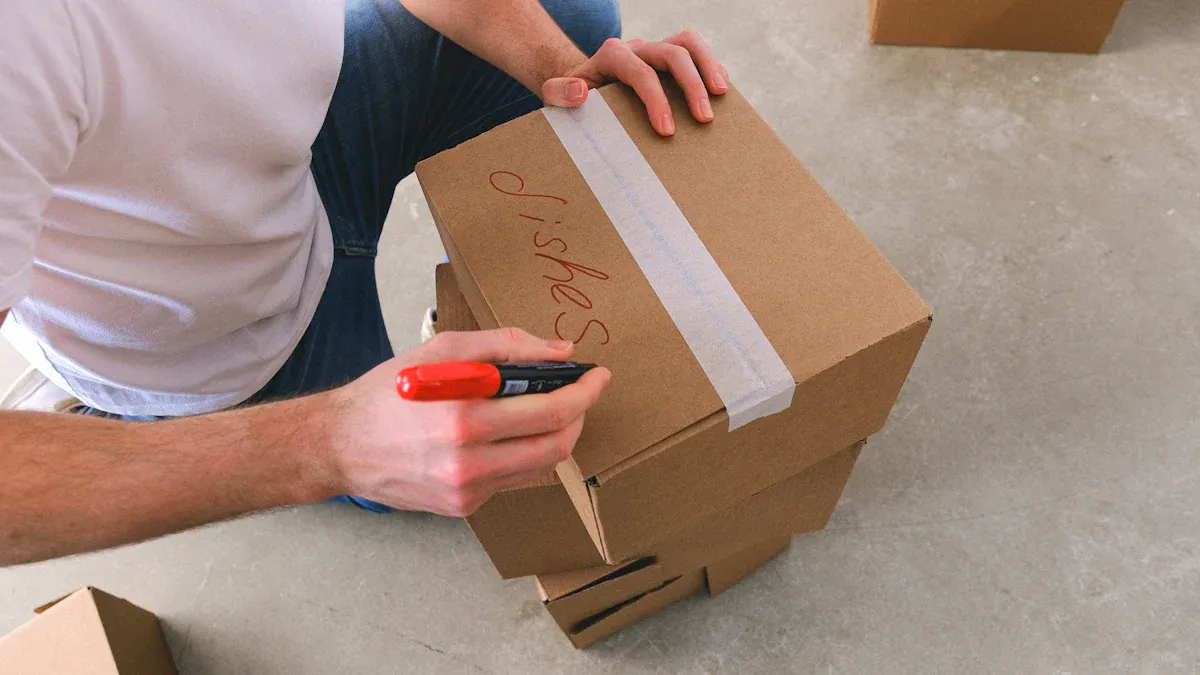
You can avoid many problems by learning about the most common mistakes people make when they measure a box. These errors can lead to wasted money, damaged products, or confusion during shipping.
You might measure the wrong side first. Always start with the longest side.
Some people mix up length and width. Remember, the length is the longest side on the base.
You may use outside measurements when you need inside measurements. This mistake can make your items not fit.
Measuring while the box is folded can give you the wrong numbers. Open the box and keep it flat before you measure.
Guessing or estimating instead of using a tool can lead to big errors.
Forgetting the thickness of the material can change the real size inside the box.
You might forget to close the flaps before you measure. Flaps can add extra length or height.
Some people misunderstand the order of dimensions. Always write them as length x width x height.
Not measuring all sides can cause problems, especially if the box has an odd shape.
Using the wrong units can confuse others. Stick to inches or centimeters and write them clearly.
Tip: Double-check your measurements before you record them. This step helps you avoid costly mistakes.
If you do not measure the box correctly, you may order the wrong size. A box that is too tight can damage your items. A box that is too loose may need extra padding, which increases shipping costs. Using the wrong size also wastes space in trucks and warehouses.
You should follow industry standards when you measure and record box dimensions. These rules help everyone understand the size and shape of the box.
Always measure the box with the flaps closed and the box fully open.
Use a flat, level surface to keep your measurements accurate.
Record the dimensions in the order of length x width x height.
Use the same units for all sides.
Check if you need inside or outside measurements for your purpose.
Note: Shipping companies and packaging suppliers use these standards to avoid confusion and mistakes.
When you follow these steps, you make sure your box fits your needs. You also help others understand the exact size, which keeps your products safe and your costs low.
You can find the size of a box by using easy steps. First, measure the length. Next, check the width. Last, measure the height. Put the box on a flat surface before you start. Write down each number after you measure. Check your numbers again to make sure they are right. Good measurements help you save money and keep your things safe when you ship them. If you follow these tips, you will feel sure about measuring any box.
Tip: Careful measuring stops expensive mistakes and keeps your boxes safe.
You measure each side separately. Write down the longest, shortest, and tallest sides. Use these numbers to describe the box. Odd shapes may need extra steps, but you always start with the main sides.
Shipping companies use dimensions to decide how much space your box takes up. They use this information to set prices and plan truck space. Accurate measurements help you avoid extra fees.
You can use a ruler or a digital caliper. These tools give you precise numbers. Always check that your tool is straight and not bent. Small boxes need careful measuring to avoid mistakes.
You should measure with the flaps closed. This gives you the true size of the box. Open flaps can change the numbers and cause errors in shipping or storage.
You write the numbers in the order of length x width x height. Always use the same units for each side. This format helps others understand the box size quickly.


