


Jewelry packaging must protect delicate products, present a premium brand image, and meet practical end-of-life requirements. For jewelry brands, choosing recyclable packaging involves more than selecting paper instead of plastic. Box construction, inserts, adhesives, surface finishes, shipping materials, and local recycling systems can all affect the final result.
This guide explains how to compare common jewelry packaging materials, reduce unnecessary material combinations, protect jewelry during transit, and evaluate suppliers before placing a bulk order. It also outlines practical checks that help buyers make more informed packaging decisions.

Table of Contents
A box made mainly from paper is not automatically recyclable in every local system. Its recyclability may depend on the paper grade, coatings, adhesives, attached components, and the recycling facilities available in the destination market.
Packaging with fewer material types is often easier to sort and process. Where practical, use paper-based components that can be separated easily from non-paper parts. Check whether the complete package, rather than just its main material, is accepted by the intended recycling program.
Before approving a design, review these points:
Identify the materials used in the box, insert, closure, ribbon, and outer mailer.
Check whether coatings, laminations, or adhesives may affect paper recovery.
Determine whether consumers need to separate any components before disposal.
Verify local recycling guidance for the markets where the product will be sold.
These terms describe different end-of-life outcomes. They should not be used interchangeably in product descriptions or sustainability claims.
Term | What it means | What buyers should check |
|---|---|---|
Recyclable | A material or package can be collected and processed into usable material under suitable conditions. | Local collection access, sorting requirements, and acceptance of the complete package. |
Biodegradable | A material can break down through biological processes under specific conditions. | The conditions, timeframe, and evidence supporting the claim. |
Compostable | A material is designed to break down in specified composting conditions. | Whether industrial or home composting is required and whether suitable facilities are available. |
For many jewelry brands, paper-based packaging can be a practical starting point. However, the best option depends on the product, distribution market, protective requirements, and local waste infrastructure.
Do not assume that a package is widely recyclable simply because it contains paper or carries a recycling symbol. A recycling label should reflect the package design and the rules of the target market.
For example, How2Recycle provides disposal guidance for the United States and Canada, while other markets may use different systems. Choose the labeling approach that applies to your customers’ locations, and avoid unqualified claims such as “100% recyclable” unless the claim is appropriately substantiated and permitted.
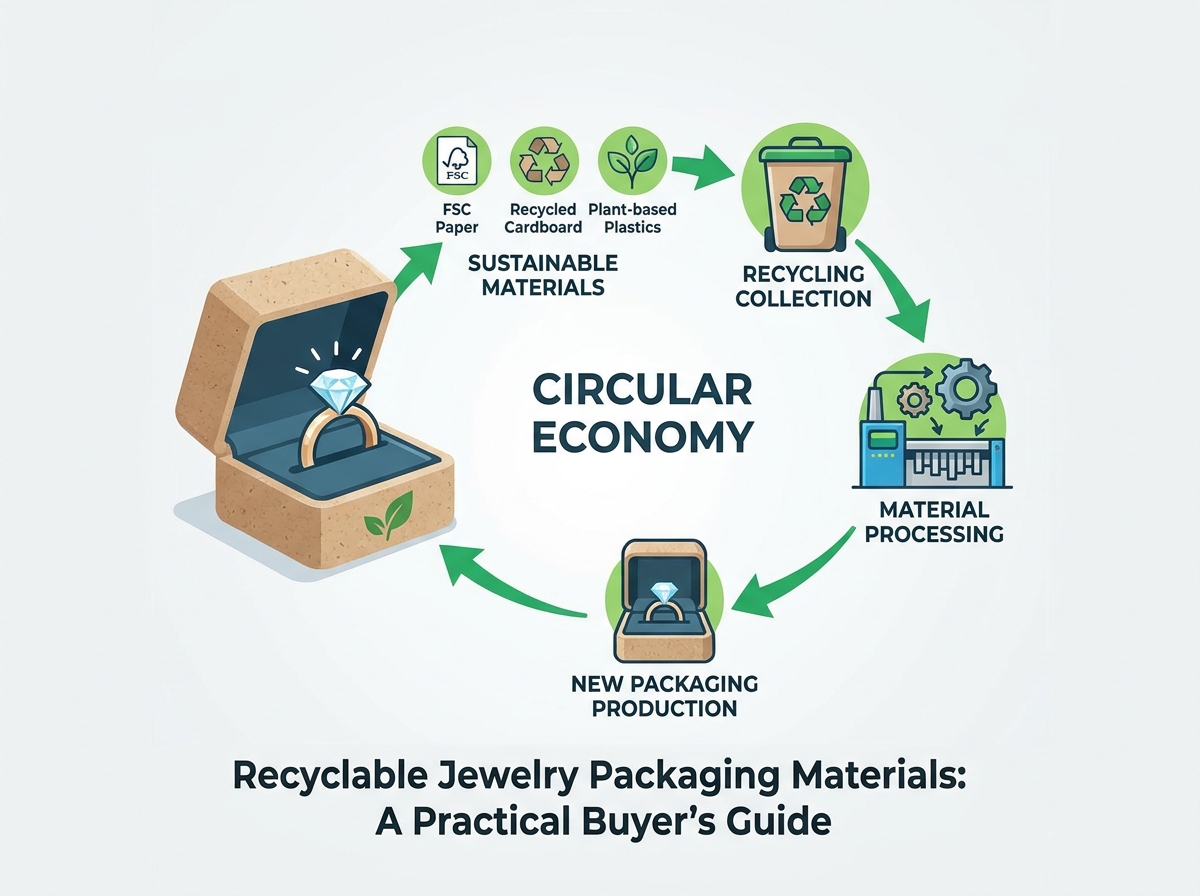
Paperboard is widely used for jewelry cartons, folding boxes, rigid boxes, paper sleeves, and packaging cards. It offers flexible printing and finishing options, making it suitable for brands that want to combine product protection with a consistent visual identity.
Folding cartons can reduce storage space because they may ship flat. Rigid boxes can provide a more substantial presentation, but they may take up more space during storage and transport. The right choice depends on product value, shipping conditions, display needs, and the overall packaging budget.
When selecting paper-based packaging, ask suppliers about:
Paper grade, thickness, and available recycled content.
The availability and scope of any relevant sourcing certifications.
Coatings, adhesives, laminations, and other added materials.
Whether the complete construction is accepted by the target market’s recycling system.
Sample testing results for strength, fit, and appearance.
ITIS offers customizable paper-based jewelry packaging. Explore its custom jewelry box solutions to compare structures, materials, inserts, and branding options.
Corrugated board can provide cushioning and structural support for outer shipping cartons. It is worth considering when jewelry boxes need additional protection during distribution.
The outer shipping box and the jewelry presentation box serve different purposes. A premium rigid box may be appropriate for retail presentation, while a corrugated carton can provide a protective shipping layer. Buyers should evaluate both parts together to avoid unnecessary bulk or material use.
When comparing shipping options, consider package dimensions, product weight, stacking conditions, delivery distance, and the risk of impact. Use samples to check whether the packaging protects the jewelry without excessive empty space.
Molded pulp can be shaped to hold jewelry or support inner packaging. Its appearance, surface smoothness, and dimensional precision vary by manufacturing method and specification.
This material may suit brands seeking a paper-fiber look or a shaped insert. Before selecting it for premium jewelry, assess the finish, fit, rigidity, and ability to protect the product. Do not assume that a fiber-based material is automatically recyclable or compostable in every market; verify the actual material composition and local disposal options.
Aluminum and steel tins may be suitable for some jewelry products, especially when customers can reuse the container. Their recycling options depend on local metal collection and processing systems.
However, a metal container is not automatically the lowest-impact choice. Buyers should consider material weight, protective performance, transport requirements, and whether the container is likely to be reused. Any foam, fabric, plastic, or paper components inside the tin should also be evaluated separately.
Die-cut paperboard and folded paper inserts can hold earrings, rings, pendants, and necklaces in position. They may simplify the packaging structure when they replace separate foam or fabric components.
The insert must fit the jewelry securely without scratching the surface or allowing the item to move excessively. Its performance depends on the jewelry’s shape, weight, and dimensions, as well as the paper’s stiffness and the insert design.
Request a sample with the actual product before confirming a bulk order. Check whether the jewelry stays in place during handling and whether the insert can be removed easily.
EVA foam, sponge, velvet, satin, and other textile materials may provide cushioning or a premium tactile experience. Their presence can complicate recycling when they are permanently bonded to paperboard or combined with other materials.
These materials are not necessarily unsuitable for every packaging application. Instead, assess whether the protection or presentation benefits justify their use and whether consumers can separate the components at disposal. Where a simpler design meets the same product-protection requirements, consider it as an alternative.
Jewelry packaging should not damage the product during storage or transit. Certain paper additives, finishes, or contact materials may be unsuitable for some metals, so material compatibility should be checked rather than assumed.
For silver jewelry or other products sensitive to storage conditions, ask the supplier about relevant material specifications and request testing with the actual jewelry or a suitable sample. If anti-tarnish paper or inserts are required, verify their composition, performance, and disposal guidance.
Avoid relying on a generic claim that all recycled paper causes tarnishing. The result depends on the paper composition, processing, storage conditions, and jewelry material.
Printing and finishing can affect both appearance and end-of-life processing. Options may include standard printing, embossing, debossing, coatings, lamination, and foil stamping.
If recyclability is a priority, ask suppliers how each finish affects the complete package and whether the materials are compatible with the intended recycling stream. Uncoated paper and simple printing may be easier to assess, but no single finish should be described as universally recyclable without supporting evidence.

Blind embossing and debossing can add texture without applying a separate decorative film. They may be worth considering when the design needs a refined appearance with fewer added components. Confirm that the chosen paper and production process can deliver the required result.
Magnets, ribbons, metal fittings, and adhesives may introduce materials that differ from the main paper structure. Their impact on recyclability depends on the package design and local processing requirements.
Where practical, consider friction-fit closures, tabs, or other structures that reduce additional components. If a magnetic closure or ribbon is important to the brand experience, ask whether the component can be removed easily and whether the package needs disposal instructions.
For glued paper structures, request information about the adhesive and its compatibility with paper recycling. Avoid assuming that every water-based or hot-melt adhesive is automatically suitable for repulping. The specific formulation and amount used can matter.
The outer mailer should protect the jewelry box throughout delivery. Corrugated cartons, paper mailers, and other shipping formats may be appropriate for different order sizes and risk levels.
Choose a shipping format based on the product’s fragility, shipment route, handling conditions, and the level of protection needed. A flat paper mailer may suit documents or flat accessories, while a boxed jewelry set may need a more rigid outer carton.
To reduce unnecessary packaging, measure the complete shipment and remove avoidable empty space without compromising protection. Smaller dimensions may improve storage and shipping efficiency, but the design should still pass suitable handling tests.

The unit price is only one part of packaging cost. Buyers should also consider tooling, sampling, storage, shipping volume, damage risk, and minimum order quantities (MOQs).
Rigid boxes may offer a premium presentation but occupy more space than flat-packed cartons. Custom inserts may require die-cutting tools or setup work. Stock packaging with a paper sleeve or label may be a practical way to test a design before investing in a fully customized structure.
Ask suppliers to quote comparable specifications, including dimensions, materials, finishing, insert design, order quantity, and delivery terms. This makes price comparisons more meaningful.
Request documentation that is relevant to the materials and markets involved. Depending on your project, this may include sourcing certificates, material specifications, information about coatings and adhesives, or test reports supporting environmental claims.
Check that certificates are current, apply to the relevant supplier or product, and cover the scope being claimed. Do not treat one certificate as proof that the complete package is recyclable, compostable, or compliant with every market’s regulations.
ITIS provides customization services covering material selection, design, sampling, and production. Discuss your target market and packaging requirements with the supplier before confirming specifications.
A packaging sample should be evaluated for more than appearance. Confirm that the jewelry fits securely, the box opens and closes as intended, and the structure can withstand expected handling and shipping conditions.
Depending on the product, testing may include drop or transit simulations, compression checks, surface-contact compatibility, and storage-condition assessments. Use an appropriate test method for the actual distribution risks rather than relying on a single generic test.
Keep a record of the approved materials, construction, finishes, and sample results. This helps ensure that bulk production matches the agreed specification.
Before placing an order, confirm that you have:
Identified the target markets and their relevant recycling guidance.
Listed the materials used in the box, insert, closure, and outer packaging.
Checked whether coatings, adhesives, and attached components affect disposal.
Selected a structure that balances presentation, product protection, and shipping efficiency.
Reviewed relevant supplier documentation and substantiated environmental claims.
Tested a sample with the actual jewelry and expected shipping conditions.
Prepared clear, market-appropriate disposal instructions where needed.
Choosing recyclable jewelry packaging requires more than selecting a material with a sustainability label. Buyers should evaluate the complete package, including inserts, finishes, closures, adhesives, and outer shipping materials.
Paper-based structures can offer flexible options for jewelry brands, but actual recyclability depends on package design and local processing systems. By checking material details, testing product protection, and verifying supplier claims, brands can make more practical packaging decisions while maintaining a premium presentation.
They may be recyclable where local programs accept the paper grade and the complete package. Coatings, laminations, adhesives, and attached components can affect acceptance.
Not in every case. Magnets can complicate material separation and recycling, so check local guidance and consider designs that allow easier separation.
Paper inserts may simplify a packaging structure, but the best choice depends on the jewelry’s shape, weight, protection needs, and local recycling options. Test the insert with the actual product.
It depends on the paper composition and storage conditions. Ask suppliers about material compatibility and test the selected packaging with the jewelry before bulk production.
Review the complete material specification, relevant certificates or test reports, and local recycling guidance. Avoid broad claims unless they are supported and appropriate for the target market.


