



A standard cigarette pack is about 85 mm × 57 mm × 22 mm (3.35 in × 2.25 in × 0.87 in). A standard carton holds 10 packs and measures roughly 150 mm × 90 mm × 205 mm. These numbers matter for your brand. The right dimensions affect shelf display, shipping costs, and legal compliance. This cigarette size chart and packaging guide gives you exact measurements for every format. You will find a full cigarette size chart, pack and carton dimensions, box structures, materials, and compliance rules. Every measurement appears in both millimeters and inches. This cigarette boxes dimensions guide helps you compare options at a glance. Use this cigarette packaging reference to plan your next order with confidence.
A standard cigarette pack contains 20 cigarettes and is about 85x57x22 mm.
Cigarette sizes go from Regular 70 mm to 120s; each length changes the pack size.
Local laws change how many packs you can buy and their size. Always check the rules in your area before you order.
The box design and board thickness affect how long it lasts and how much it costs; pick the one that fits your product.
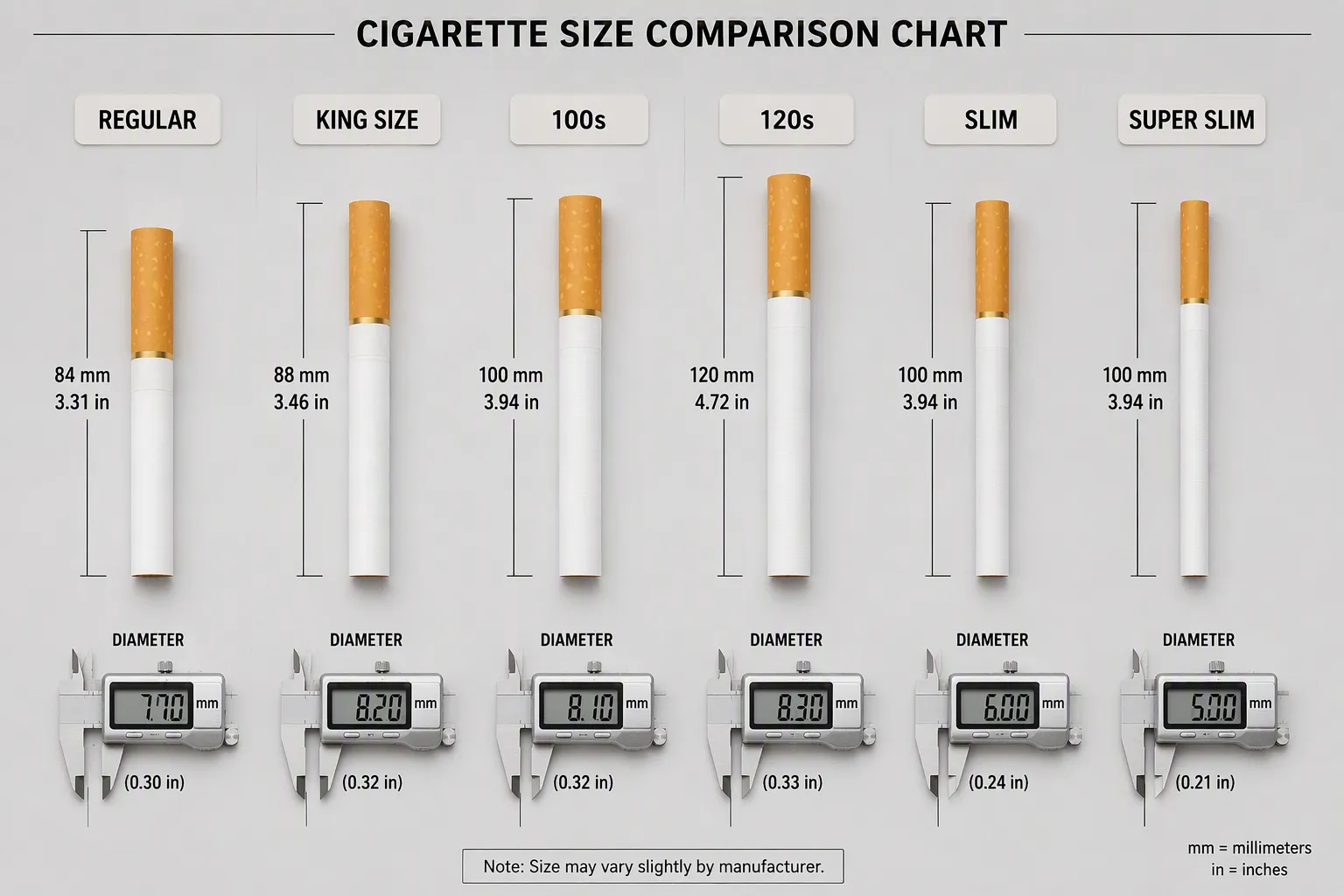
Cigarette sizes vary by length, diameter, and tobacco weight. This cigarette size chart breaks down each format so you can compare them side by side. The table below covers the most common types you will encounter in the market.
Cigarette Type | Length (mm) | Length (inches) | Diameter (mm) | Tobacco Weight |
|---|---|---|---|---|
Regular | 70 | 2.75 | 7.8–8.0 | 0.65–0.70 g |
King Size | 84 | 3.31 | 7.8–8.0 | 0.70–0.80 g |
100s | 100 | 3.94 | 7.8–8.0 | 0.85–0.90 g |
120s | 120 | 4.72 | 7.8–8.0 | 1.00–1.10 g |
Slim | 82–85 | 3.23–3.35 | 5.4–6.0 | — |
Super Slim | 82–85 or 100 | 3.23–3.35 or 3.94 | 5.0–5.1 | — |
Regular cigarettes measure 70 mm (2.75 in) in length. King-size cigarette lengths reach 84 mm (3.31 in), which is 14 mm longer than the regular format. Both share a cigarette diameter of 7.8–8.0 mm. The king-size format became the dominant global standard during the 1960s–1970s market shift. Filter length typically accounts for 20–27 mm of total cigarette length and generally matches the cigarette diameter.
The 100s format extends to 100 mm (3.94 in). This extra length adds more tobacco and a longer filter. You will notice the weight difference in the table above. A 100s cigarette holds 0.85–0.90 g of tobacco, while a king-size holds 0.70–0.80 g.

The 120s format stretches to 120 mm (4.72 in). This is the longest standard cigarette size. It carries 1.00–1.10 g of tobacco, the highest weight in this cigarette size chart.
Slim cigarettes keep the standard 82–85 mm length but reduce the diameter to 5.4–6.0 mm. Super slim formats go even thinner at 5.0–5.1 mm. Some super slim versions also come in a 100 mm length. A slim 5-count box measures about 3.5 in × 1.625 in × 0.45 in. This compact size suits trial packs and promotional runs.
The diameter reduction changes the smoking experience. A smaller cigarette diameter means less tobacco per puff and a different draw. Circumference drops from 24.5–25.1 mm for regular and king-size to 17.0–18.8 mm for slim and 15.7–16.0 mm for super slim. Micro formats shrink further to a 4.6 mm diameter and 14.5 mm circumference.
You can use this cigarette size chart to match your product to the right pack. Each format demands its own box dimensions. The next section covers standard pack sizes for 10, 20, and 25 count configurations.
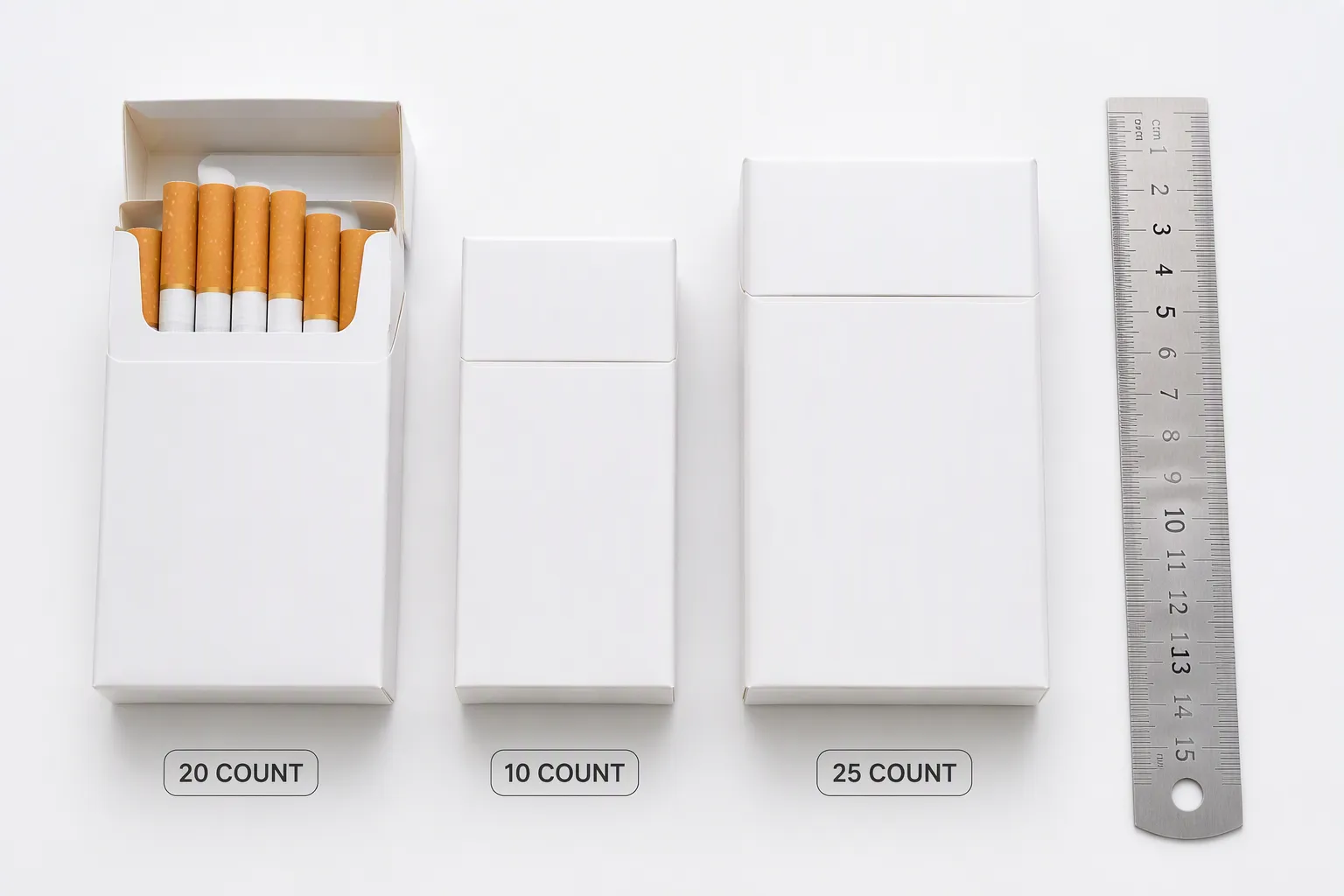
A normal cigarette pack usually holds 20 cigarettes. This amount leads the global market. The number of cigarettes in a pack shapes every other size you will read about here. When someone asks how many cigarettes come in a pack, the answer is almost always 20. That one fact drives the standard cigarette pack dimensions used across the industry.
Two main references cover most 20-count packs. The first is 85 mm × 57 mm × 22 mm (3.35 in × 2.25 in × 0.87 in). The second is 85 mm × 55 mm × 20 mm (3.35 in × 2.17 in × 0.79 in). These numbers show the standard cigarette pack size for king-size products. Marlboro packs often use 85 mm × 55 mm × 22 mm. This brand example shows how one millimeter in depth can set one product line apart from another.
The 20-count format sets the baseline for cigarette box dimensions worldwide. A 10-count pack cuts the width about in half while keeping the same height and depth. This smaller format works well for trial offers and travel retail. The 20-count packs stay the volume leader in every major market.
Regional rules change the standard cigarette box dimensions you will see. Consider these common 20-cigarette pack measurements:
North America: Width 92 mm (3.63 in), Height 72 mm (2.83 in), Depth 21 mm (0.83 in)
Europe/UK: Width 88 mm, Height 55 mm, Depth 23 mm
Australia: Width 85 mm, Height 58 mm, Depth 21 mm
These differences reflect local labeling laws and retail display norms. A 25-pack offers another option. Its approximate dimensions appear below.
Pack Size | Approximate Dimensions (mm) |
|---|---|
25-pack | 86 mm × 66 mm × 23 mm |
The 25-count format adds five cigarettes and a few millimeters in width. This cigarette box size works well for value-focused buyers. The cigarette packet dimensions for a 25-pack stay close to the 20-count standard, so retailers can stock both without redesigning shelves.
Larger counts serve different markets. A 30-count pack targets heavy smokers and bulk buyers. A 50-count pack often appears in duty-free channels and institutional sales. These formats scale up the standard cigarette pack sizes you already know. The width grows to hold more cigarettes in a single row or a double stack. The height and depth change less because the cigarette length stays fixed.
You will find fewer published figures for these larger formats. Manufacturers treat them as custom runs rather than universal standards. The cigarette box sizes for 30 and 50 counts depend on the cigarette diameter and the internal tray layout. A slim cigarette allows a narrower box at the same count. A king-size cigarette demands more width per stick.
The number of cigarettes in a pack also affects carton planning. A carton holds 10 packs of 20, which equals 200 cigarettes. Larger packs reduce the pack count per carton. This change ripples through shipping, shelf space, and tax stamp placement. You should confirm the exact cigarette pack dimensions with your supplier before you finalize any order. The next section covers carton dimensions and how regions differ.
A normal carton has 10 packs of 20 cigarettes. That makes 200 cigarettes in total. The exact size of the carton changes based on where you are. You must know these differences for shipping, putting on shelves, and planning sales. A carton that fits well in one market might not work in another.
North American cartons are about 11 by 3.5 by 1.8 inches. In metric, that is about 28.4 cm by 8.6 cm by 4.6 cm. This size comes from putting ten packs in two rows of five. Each normal pack in North America is about 3.5 by 2.25 by 0.88 inches. If you sell 100s or slim cigarettes, your carton might be a bit longer or narrower to fit the different cigarette size.
European cartons use a different standard. They match the king‑size pack sizes common in that area. Asian markets also change based on local pack counts. You should always check your carton sizes against your pack size before ordering production. A small change in pack width can change the whole carton layout.
Governments around the world make rules that change pack and carton sizes. These rules aim to control how much people smoke and keep them safe. The rules directly affect the sizes you must use.
The United States says packs must have exactly 20 cigarettes. This rule makes taxes and warning labels the same for all brands. Canada and Australia let packs have 20 or 25 cigarettes. Health warnings cover a large part of the pack surface. This rule can make packs a bit thicker. In Australia, packs may be up to 25 mm thick to fit the big warnings. The European Union sets a minimum of 20 cigarettes per pack to stop small, cheap packs that target young people. The United Kingdom adds plain packaging rules that limit branding to simple fonts and colors.
The number of cigarettes in a pack directly affects your final carton dimensions. Here is a comparison of regional pack counts:
Region | Per Pack | Total in Carton |
|---|---|---|
Asia, Europe | 10-20 | 200-400 |
Malaysia | Min. 20 | 400 |
Canada | 25 | 500 |
Ireland | 33 | 660 |
Australia | Up to 50 | Up to 1000 |
Each change in pack count changes the carton width and height. A 25‑count Canadian pack makes a thicker carton than a normal 20‑count. You must plan for these changes when ordering packaging for different markets. Check your local rules first, then check carton sizes with your supplier.
The flip-top hinged lid dominates cigarette packaging styles worldwide. It feels structured, opens smoothly, and presents branding well. An inner frame supports the lid and controls the closing action. You will find this format in king size 20-count packs at 3.4 x 2.2 x 0.85 inches, built from 18pt SBS board. The 100s 20-count version measures 3.9 x 2.2 x 0.85 inches with the same board. Scored hinge lines allow one-handed thumb-flip operation. Durability testing verifies reliable opening through a minimum of 200 open-close cycles per pack.
Soft packs use flexible board wrapped in film. They lower cost per unit and suit high-volume value lines. A soft pack outer measures 3.5 x 2.3 x 0.9 inches from 16pt board. Slide boxes separate into an outer sleeve and an inner tray. This design creates a premium unboxing experience for boutique brands and limited editions. Slim 20-count slide boxes measure 3.7 x 1.8 x 0.7 inches. Super slim versions shrink to 3.7 x 1.6 x 0.6 inches from 16pt board.

Board caliper for cigarette boxes ranges from 0.35 mm to 0.50 mm. Increasing caliper from 0.35 mm to 0.50 mm adds 0.15 mm to each wall. This reduces internal width by about 0.30 mm if external dimensions stay fixed. Flip-top hard packs use 330–360 gsm SBS board. Slide boxes need an outer sleeve of 350–400 gsm and an inner tray of 250–300 gsm. Tuck-end cartons run 280–320 gsm. Heavier SBS board adds caliper that resists panel flex during pocket carry.
The inner foil liner acts as a structural element. Laminated aluminum foil at 30–35 gsm preserves freshness and prevents moisture loss. A small cardboard collar holds cigarette sticks upright and supports the lid area. Material choice affects durability. Kraft is more tear-resistant than cardboard, while cardboard offers a smoother surface for vibrant printing.
Governments make strict rules about what goes on every pack. The WHO FCTC Protocol says tax stamps must be used to stop illegal trade. FCTC Article 11 suggests picture warnings with text at the top of the display area. These warnings should cover at least half of the surface. Since May 2016, the EU Tobacco Products Directive 2014/40/EU requires combined warnings that cover 65% of the front and back.
The European Union's updated Tobacco Products Directive lets Member States make health warnings bigger — up to 65% on the front and back, and 50% on the sides of the pack.
Tax stamps and warnings often get in each other's way. A TPackSS study found that 8 of 14 low- and middle-income countries had rules to keep tax stamps from covering warnings. But in Brazil, Indonesia, Thailand, and Viet Nam, 64.3% of packs had stamps blocking the warning. You need to plan where stamps go early so you meet regulatory requirements compliance in every market.
The printing method you pick affects how well compliance features come out. Gravure printing uses solvent-based ink and covers more than 60% of all cigarette packets. Sheet-fed offset printing uses UV ink for medium and high-end products. Other methods like screen printing handle special effects.
Digital printing: short runs, prototypes, variable data like QR codes
Gravure printing: very large orders that need consistent color
Flexographic printing: multipack cartons and shipping cases
Screen printing: decorative areas and limited-edition sleeves
Gravure and offset are different in key ways. Gravure has lower registration accuracy, so use spot colors for text. Barcodes printed by gravure have jagged edges and scan poorly. Offset works well for short runs and frequent design changes. Gravure wins on long-run cigarette packaging jobs after multiple reprints. Test die-cut plates and ink flexibility before batch printing.
Custom dimensions affect your tooling needs. A new die-cut plate costs money and time. You pay for that setup just once. The plate then works for your whole order. A request for custom cigarette box dimensions also changes your minimum order amount. Standard sizes use existing tools. Custom sizes need new tools. That difference makes each box cost more on small runs.
Minimum order amounts change based on product type. Most standard custom cigarette boxes start at 50 units. Special rigid boxes and special structures start at 100+ units. Some suppliers have no minimum at all. You can order as few boxes as you want.
Is there a minimum order amount for custom cigarette boxes?
A: No, there is no minimum for cigarette boxes. You can order as few as you like.
Lead time goes up with complexity. A simple size change adds a few days. A new structural design adds weeks. Confirm both tooling cost and lead time before you decide.
Start with your cigarette. Measure its length and diameter. A standard box size must fit the stick with a little extra space. Too tight can damage the cigarette. Too loose lets it rattle. You need exact measurements for every type.
Follow these steps to specify your box:
Use calipers to measure the cigarette's length and diameter.
Add some extra space for the inner liner and collar.
Measure the outer box size you want.
Write down the height, width, and depth in millimeters.
Compare your numbers to standard cigarette box dimensions.
Give your supplier a physical sample or a detailed drawing.
Your box measurement must include the outer board thickness. Board caliper ranges from 0.35 mm to 0.50 mm. That thickness changes the inside space. You must account for it in every cigarette box sizes request. A good supplier will check your numbers against their tooling. This step prevents costly mistakes in your cigarette packaging order.
This cigarette size chart and packaging guide gives you all the key measurements. A standard cigarette pack size measures 85 mm × 57 mm × 22 mm. The number of cigarettes in a pack directly changes the cigarette box dimensions. Regional rules also shift cigarette box sizes across different markets. Box structure and materials connect to your size choices. Flip-top packs use different board caliper than slide boxes. Compliance features like warning labels affect pack depth too. Use this reference for your cigarette packaging needs. Consult a packaging supplier to confirm your design. Download a full size chart to keep these numbers handy.
A standard pack holds 20 cigarettes. This count sets the baseline for most pack dimensions worldwide. Some markets allow 25-count packs, and duty-free channels may carry 30 or 50. Always confirm the count with your supplier before you finalize box dimensions.
Most 20-count packs measure 85 mm × 57 mm × 22 mm (3.35 in × 2.25 in × 0.87 in). A second common reference is 85 mm × 55 mm × 20 mm. Marlboro packs often use 85 mm × 55 mm × 22 mm. Small depth changes set one brand apart from another.
A standard carton holds 10 packs of 20 cigarettes, or 200 total. It measures roughly 150 mm × 90 mm × 205 mm. Regional rules change this size. Canada uses 25-count packs, which makes a thicker carton. Always check local rules before you order.
Yes. More cigarettes mean a wider or deeper box. A 25-pack measures about 86 mm × 66 mm × 23 mm. Slim cigarettes allow a narrower box at the same count. You should match your box size to both the cigarette diameter and the pack count.
Board caliper ranges from 0.35 mm to 0.50 mm. Flip-top hard packs use 330–360 gsm SBS board. Slide boxes need 350–400 gsm for the outer sleeve and 250–300 gsm for the inner tray. Heavier board resists panel flex during pocket carry.